
Compiled by Parker Lamothe, Communications Associate, Global Ties U.S.
Editor’s Note: In Summer 2026, international government officials, legal professionals, and constitutional experts visited the United States as part of the U.S. Department of State’s International Visitor Leadership Program (IVLP) Freedom 250 Initiative to examine the enduring legacy of the U.S. Constitution. As the world’s longest active, codified, written charter of government, the U.S. Constitution established a framework of democratic governance that has influenced constitutional systems around the world. Through this IVLP, participants explored the Constitution’s lasting impact across the United States and beyond. Read the stories below to discover how five Community-Based Member organizations (CBMs) welcomed IVLP participants into their communities to learn more about the U.S. Constitution’s formation, implementation, and impact.
Virginia
Snapshot by Andrew Needham, The Presidential Precinct
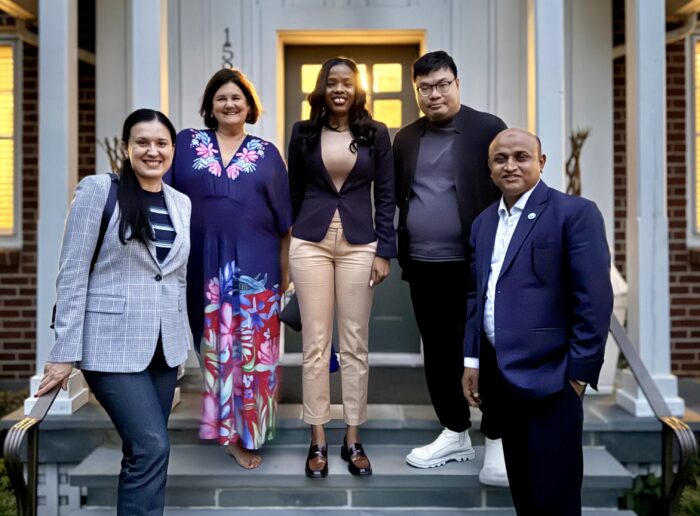
Photo by Steve Diggs, Home Hospitality Host
When international professional leaders arrived in central Virginia for the Freedom 250 IVLP, they dove right into the region’s rich history and the enduring influence of the U.S. Constitution.
Hosted by the Presidential Precinct, the visitors explored presidential homes, engaged with local and state government leaders, and enjoyed local culture and hospitality in an experience that one visitor, the dean of a law school in the Philippines, described as having “a lasting impact on my professional and academic work.”
At the home of James Madison, the leaders learned about “The Father of the Constitution” and his essential contributions to the Virginia Plan, Constitution, and Bill of Rights. With constitutional scholars, they discussed the history of constitutionalism and examined the Constitution’s philosophical aspect related to freedom, dignity, and responsibility, as well as its impact on modern America. At Thomas Jefferson’s Monticello, they learned about Jefferson’s role in shaping America’s early political and philosophical foundations.
During another interactive session, the visitors explored the role of dual constitutionalism within American federalism, including the powers of the state government versus local government; the role of the Supreme Court; and many more. “This is exactly what we needed after our federalism briefing in Washington, DC!” said one visitor.
In Richmond, visitors learned about civics education at the Virginia Museum of History and Culture, whose programs focus on constitutional literacy, civic engagement, and ways to modernize and expand tools for understanding the Constitution and its global legacy.
The professional connections made throughout the program sparked ideas for future projects and collaborations. One visitor reported exploring potential partnerships with new connections at the Library of Congress. Another aims to strengthen collaboration with the U.S. Embassy in her home country. One visitor shared, “The warm hospitality of the American people inspires me to foster meaningful innovation back home.”
New York
Snapshot by Beth Wales, International Center of the Capital Region
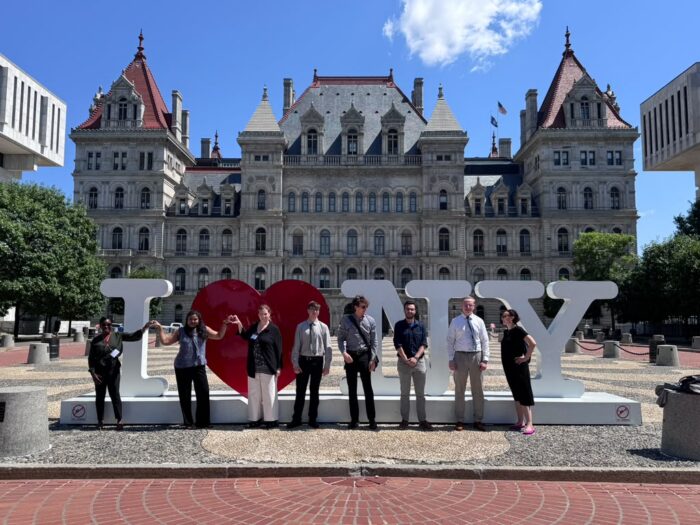
Photo by Brittany Lynk, IVLP Liaison
In July 2026, The International Center of the Capital Region (ICCR) hosted international professionals from Bosnia and Herzegovina, Estonia, Jamaica, and Sri Lanka as part of the IVLP Freedom 250 Initiative’s program on the U.S. Constitution. Across courts, universities, museums, government institutions, community settings, and informal gatherings, the leaders experienced the Constitution as a living framework that continues to shape American life.
The program began at the Van Schaick Mansion, where the historic site’s staff shared that the plans for the Battles of Saratoga, a turning point in the American Revolution, were drawn up within the mansion’s walls. For a program focused on the enduring legacy of the Constitution, beginning in a place so closely connected to the nation’s founding created a meaningful bridge between America’s revolutionary history and the constitutional system that followed.
At the U.S. District Court for the Northern District of New York, the group experienced a particularly memorable moment when the Bosnian participant, preparing to become a Supreme Court judge in her country, asked the judge how life changes after such an appointment. The judge‘s candid response created a connection between the two who are navigating similar responsibilities of high judicial office in varying constitutional systems.
The Court of Appeals visit also demonstrated the reciprocal nature of international exchange. The court selected a photograph of the IVLP group for its collection of tour photographs maintained by the Clerk’s Office, a small but meaningful reminder that exchanges leave lasting impressions on local institutions as well as visitors.
At the University at Albany, the leaders met with faculty scholars with expertise in American politics and constitutional issues. The conversation examined the relationship between civic engagement, public opinion, legislation, and constitutional debate. The discussion was so lively that, afterward, the professors continued talking enthusiastically about the participants’ thoughtful questions and perspectives.
This exchange and the resulting relationships benefited both local participants and the international professionals. American judges, professors, students, court staff, community leaders, families, and volunteers had the opportunity to engage directly with their international counterparts. Local participants were not simply explaining American institutions to international visitors; they were also learning how democratic institutions and constitutional principles are understood and experienced elsewhere.
Through this IVLP, the ICCR team built new relationships, showcased new perspectives, and fostered a deeper appreciation amongst the local community and this IVLP group for the ways constitutional democracy is understood in the United States and around the world.
New Hampshire
Snapshot by Anise Jasman-Sayers, World Affairs Council of New Hampshire
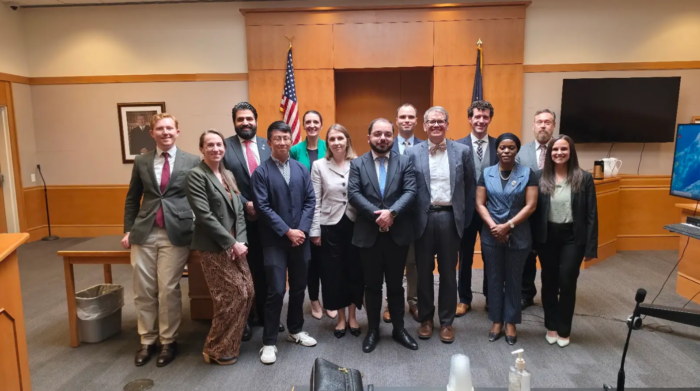
Over the Fourth of July, the World Affairs Council of New Hampshire welcomed international legal and government professionals participating in the IVLP Freedom 250 Initiative. The group had a unique opportunity to learn about American civic life while the country and communities across New Hampshire celebrated the nation’s 250th anniversary.
Throughout the week, the group learned about the Constitution from several different perspectives. The group explored federalism and local government, toured the New Hampshire State House, discussed civic education, learned about New Hampshire’s role in civic participation, and met with the Manchester Police Department to discuss constitutional rights and the responsibilities of law enforcement.
At the same time, our New Hampshire partners were learning about the visitors’ government systems, and new relationships developed among individuals who otherwise may never have met.
One of the conversations that stood out most came at a local courthouse where a judge, a prosecutor, public defenders, a law student, and our international legal professionals sat together to talk about how constitutional protections operate within the justice system.
A prosecutor from Georgia told us that although he already understood the constitutional principles behind the U.S. criminal justice system, hearing directly from practitioners gave him “a much deeper appreciation of how those principles function in practice.”
A Romanian judge was struck by the respectful relationship he saw between the judge, prosecutor, and defense attorneys. In his system, he explained, those professionals tend to remain much more separate.
The visitors were not simply discussing the Constitution as a document written nearly 250 years ago. They witnessed the many ways it continues to influence citizenship, government, public safety, the courts, and civic participation today.
This programming showcased international exchange in action.
Experiencing these exchanges over the Fourth of July and during America’s 250th anniversary made this opportunity especially meaningful. It connected American history with what the Constitution looks like in practice, while giving the international leaders and New Hampshire partners the chance to consider the Constitution’s influence from varying perspectives.
Wisconsin
Snapshot by Anna Savary, International Institute of Wisconsin
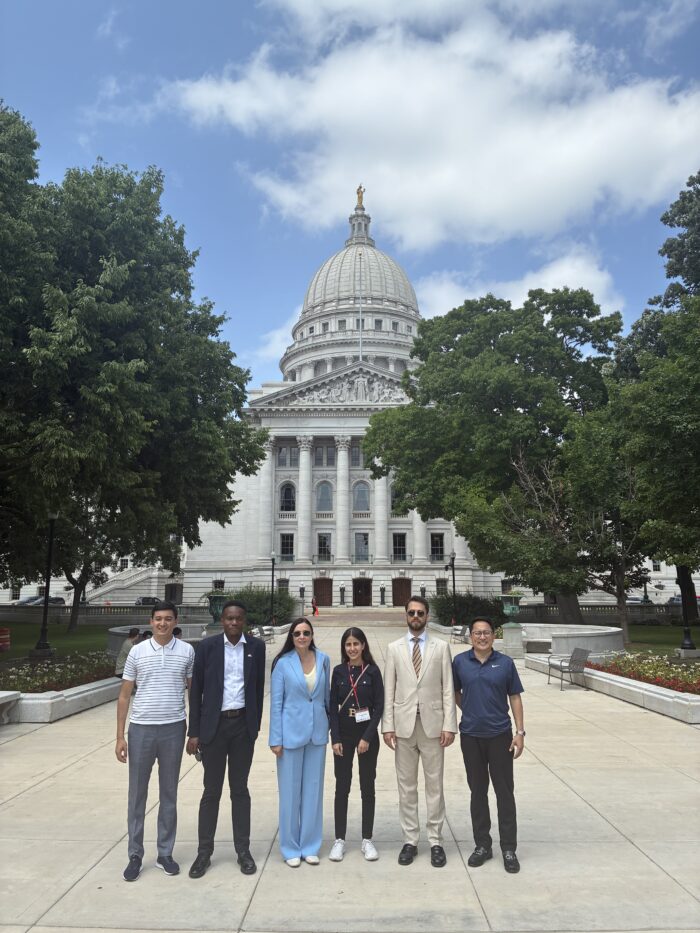
In celebration of the 250th anniversary of American independence, the International Institute of Wisconsin welcomed international visitors participating in the IVLP Freedom 250 Initiative. The visit provided participants with opportunities to explore how constitutional principles continue to shape democratic institutions, civic engagement, and the rule of law in the United States.
One of the most memorable experiences was a visit to the Wisconsin Historical Society, where participants viewed an original Dunlap & Claypoole broadside of the U.S. Constitution, printed in Philadelphia on September 19, 1787, just two days after the Constitution was signed. Seeing this historic document firsthand connected discussions about constitutional principles to a tangible piece of American history.
The program also strengthened connections with the Wisconsin Society Sons of the American Revolution (SAR) and the Wisconsin Society Daughters of the American Revolution (DAR). Both organizations are long-time exhibitors at the International Institute of Wisconsin’s signature Holiday Folk Fair International, making this exchange an opportunity to deepen an existing community relationship. Their work preserving Revolutionary-era history, recognizing civic and public service, supporting veterans, and promoting the principles expressed in the Constitution’s Preamble provided participants with another perspective on how Americans engage with their constitutional heritage.
Hosting this IVLP group during America’s 250th anniversary year was especially meaningful. It offered an exciting opportunity to celebrate the Constitution as a historic document, and to demonstrate its enduring influence throughout Wisconsin. The exchange reinforced that America’s constitutional story is both national and global, one that continues to inspire dialogue about democracy, freedom, civic responsibility, and the rule of law across generations and borders.
Alabama
Snapshot by Annette Philpo’t, Global Ties Alabama
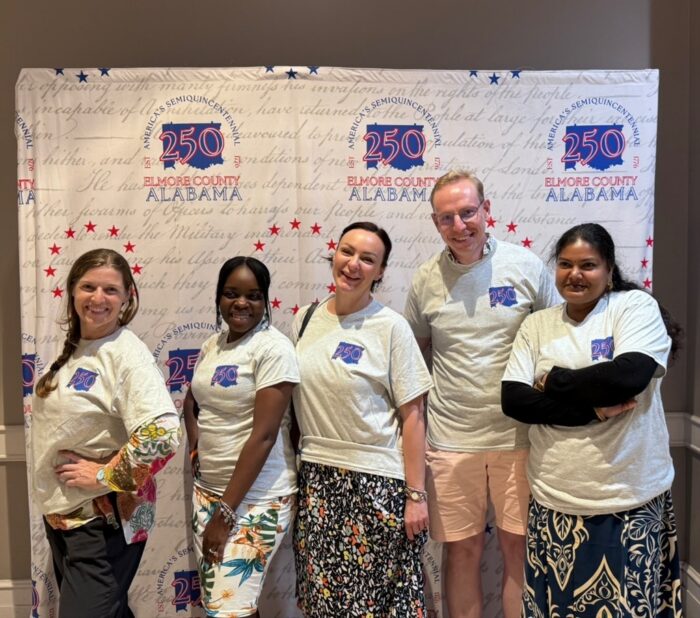
Photo by Brittany Lynk, IVLP Liaison
Global Ties Alabama hosted international visitors from Bosnia, Estonia, Jamaica and Sri Lanka as part of the IVLP Freedom 250 Initiative program on the legacy of the U.S. Constitution.
Participants had the opportunity to hear from local professionals, tour historic sites, engage in presentations, and observe civic life in cities and towns of different sizes across Alabama.
The group was warmly welcomed in Montgomery and enjoyed dinner with their local hosts before the start of their professional program. They had the opportunity to celebrate the 250th Anniversary in Wetumpka, Alabama, a town with less than 10,000 people. The community gathered to share stories and perform music depicting the early history of the United States.
Building on their Freedom 250 programming, the group traveled to American Village, an educational treasure that teaches and inspires participants about the foundations of U.S. liberty and constitutional self-governance.
One of the most beneficial appointments was with the City of Montgomery Police Department (MPD). The department shared how the MPD approaches its duty to protect the U.S. Constitution through specific policies, sworn oaths, and independent oversight. Dialogue between MPD and the international visitors was extensive, and the visiting leaders departed the State of Alabama with more knowledge of the U.S. Constitution and its enduring significance.