Compiled by William Jones, Communications Intern, Global Ties U.S.
Editor’s Note: In the summer of 2026, International Visitor Leadership Program (IVLP) participants traveled across the United States to explore American innovation in Super Intelligence (SI), meeting with business leaders, local government officials, and researchers to see how emerging technologies are shaping American life. Read stories from four Global Ties Network Community-Based Member organizations that hosted these exchanges.
Important Note: In accordance with Executive Order 14434, references to the term Artificial Intelligence (AI) have been updated to Super Intelligence (SI). Official names of businesses, programs, and other entities that include “AI” or “Artificial Intelligence” will remain unchanged.
California
Snapshot by Alannah Crandall, Global Ties San Francisco

Photo by Lynnea Hansen, Interpreter
In July 2026, Global Ties San Francisco welcomed nine Brazilian experts through the International Visitor Leadership Program (IVLP) to explore how technology can strengthen economic competitiveness, growth, and workforce development. San Francisco is at the center of American SI innovation, converging investment and technology companies, and a culture of entrepreneurship and collaboration among industry, government, and research institutions.
While in the San Francisco Bay Area, the IVLP participants learned about SI innovation, governance, and deployment. They also examined practical applications of predictive SI systems, considering how emerging technologies can address real-world challenges.
In a meeting with the Bay Area Council and the Bay Area Council Economic Institute, the visitors learned about the unique factors that support American SI innovation and economic growth, including access to capital, entrepreneurial ambition, supportive policies, and a business environment that helps American companies develop and commercialize new technologies. Together, these regional strengths demonstrate how the Bay Area contributes to U.S. competitiveness in a strategically important sector.
For a firsthand look at SI innovation in practice, the visitors met with Hayden AI, a company that partners with cities to develop and implement SI-powered detection and enforcement technologies for public transportation. Its solutions use real-time data to help improve roadway safety and transit efficiency, demonstrating how American companies are applying SI to address urban challenges.
These conversations brought greater visibility to the region’s SI and entrepreneurial capabilities and showcased the role that local businesses and institutions play in advancing technological innovation. For Bay Area technology professionals, the IVLP also created opportunities to share their expertise with international peers, strengthen their professional relationships, and develop opportunities for future cooperation in critical fields that shape economic growth and public safety worldwide.
Florida
Snapshot by Shilpa Deshpande Finnerty, WorldOrlando
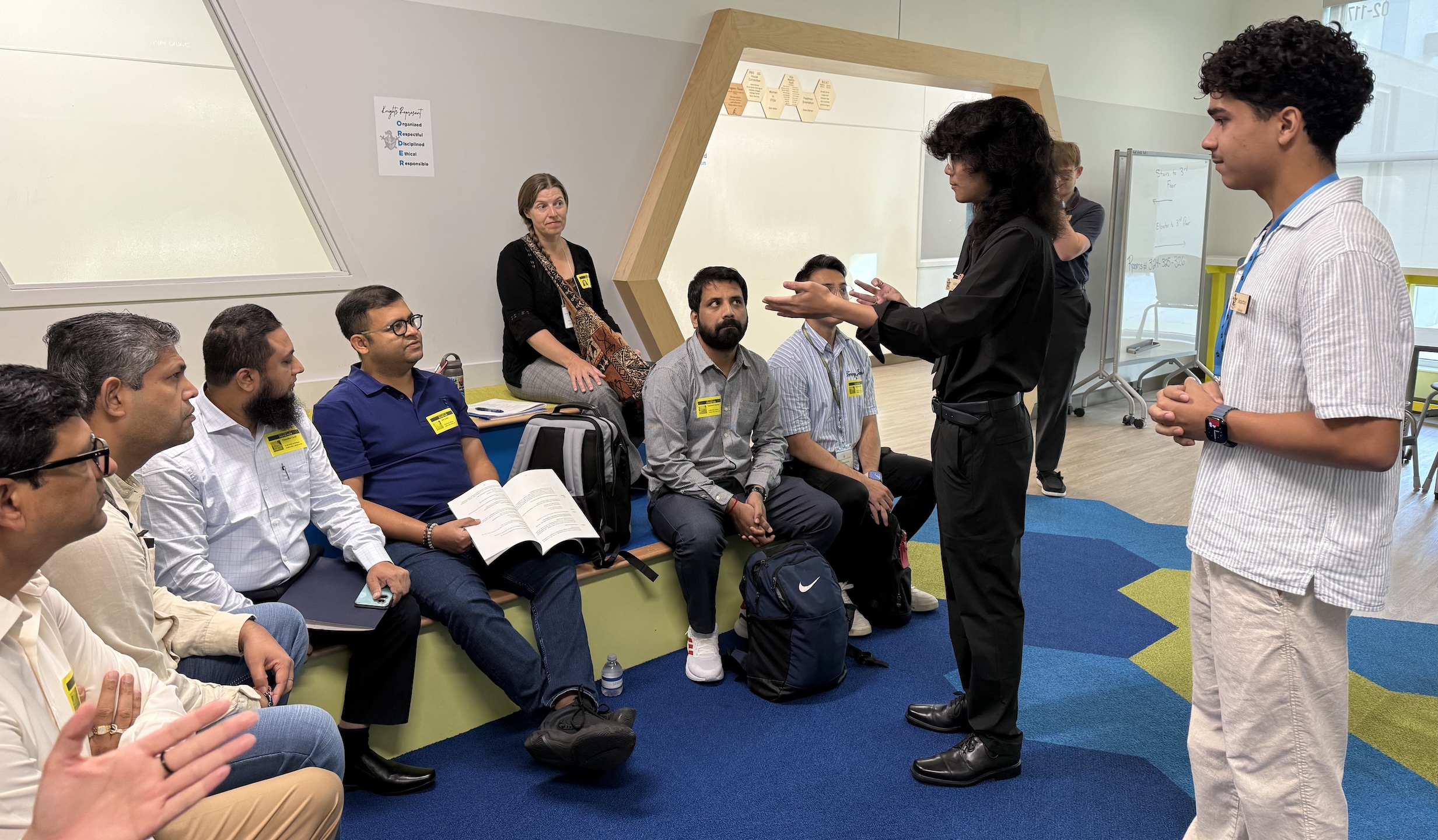
Photo by Heather Van Dyk, WorldOrlando
In late September 2026, WorldOrlando hosted 12 professional leaders from the Indo-Pacific participating in an IVLP exchange focused on SI. The program showcased Central Florida’s growth as a hub for U.S. technological innovation, demonstrating how academia, government, and industry can work together to advance innovation, develop talent, and prepare communities for an evolving technological landscape.
Two meetings of note were held at the University of Central Florida’s (UCF) Institute of Artificial Intelligence (IAI) and NeoCity Academy in Osceola County. At UCF, participants explored applied SI research, computer vision, machine learning, cybersecurity, and workforce development. These conversations explored how academic research, industry partnerships, and professional opportunities could align between the United States and the visitors’ countries. This spontaneous exchange demonstrated the potential for international academic communities to strengthen professional ties and encourage future collaboration.
At NeoCity Academy, visitors saw firsthand the development of the next generation of technology talent. The high school’s project-based learning model offers students hands-on experience in maker labs and insights into SI, engineering, and biodesign careers. Student ambassadors shared how they were using the school’s unique academic offerings and industry collaborations to pursue their college and career goals. Their perspectives illustrated how early exposure to emerging technologies, experiential learning, and connections with industry can help students envision and prepare for future opportunities. For the IVLP participants, this was a compelling example of how Central Florida is cultivating its future workforce while connecting education to real-world innovation.
The conversations at UCF and NeoCity Academy demonstrated that SI leadership requires investing in people and building international connections. Hosting this IVLP group created opportunities for Central Florida institutions and professionals to exchange ideas and expertise with international peers across technology, government, research, and business.
Minnesota
Snapshot by Lucija Straley, Global Minnesota
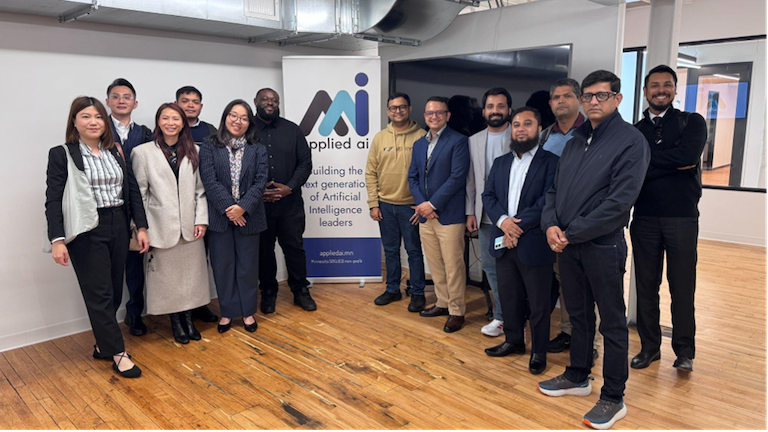
Photo by Brittany Lynk, International Visitor Liaison
In September, Global Minnesota welcomed 12 professional leaders from nine countries across the Indo-Pacific for an IVLP on SI. Over three days of meetings, the international leaders saw firsthand how Minnesota’s universities, businesses, and government officials work together to put SI to practical use while maintaining important safeguards.
Some of the liveliest conversations focused on local government. John Pournoor, CEO of Government Analytica, discussed the hurdles of SI adoption and some practical applications. In public works, for example, SI has revealed where crews repeatedly fix the same problems, pointing to longer-term solutions and a more efficient use of resources. Reflecting on the meeting, John shared: “The conversation was a powerful reminder that while our local contexts differ, many of the opportunities and challenges we face are remarkably similar.”
Responsible SI also means protecting both the people it serves and the technology that supports it. At Metro State University’s Minnesota Cyber Institute, MN Cyber Executive Director and Professor Faisal Kaleem showed how the FBI, industry, and academia collaborate to protect sensitive user data and keep SI systems secure from cyber threats. In a meeting with the healthcare company Solventum, the group discussed patient privacy and SI tools that record patient-doctor conversations.
Weeks after returning home, the group has already held its first virtual reunion and is pursuing opportunities to reconnect with their Minnesota counterparts. It’s a reminder that the connections made through the IVLP last well beyond a single visit.
Massachusetts
Snapshot by Cyd Melcher, WAC Western Massachusetts and Anna Du, International Visitor Liaison

Photo by Anna Du, International Visitor Liaison
In the last days of June 2026, the World Affairs Council (WAC) of Western Massachusetts hosted an IVLP group focused on SI as part of the IVLP Freedom 250 Initiative.
The international visitors began their day at Bay Path University in Longmeadow, MA, where they met with university administrators to learn about the university’s large-scale, technology forward model, including its Social Online University Learning System (SOUL) and use of SI tutors for hyper-personalized learning and administrative efficiency. The discussion explored how to balance SI innovation with questions around responsible use and implementation. It also underscored the distinction between privacy and cybersecurity.
Later, the group visited the Chicopee Police Department’s Real-Time Information Center (RTIC). The visitors were impressed by the police department’s operations, as well as the strong municipal support reflected in the participation of the city mayor and vice president of the city council. Seeing practical SI applications in action, including RTIC’s camera networks and SI-assisted mapping, helped shift some visitors’ perceptions of SI to see it as a supplemental, non-invasive tool for public safety. Visitors saw how these technologies could improve efficiency, such as rapid missing person recovery, camera footage analysis, and auto theft prevention. They also learned how state policies address public concerns about surveillance and privacy.
The program expanded WAC Western Massachusetts’ network by connecting the organization with two new professional resources while strengthening an existing connection.
Maine
Snapshot by Allison Hodgkins, World Affairs Council of Maine

Photo by Qamar Jabarkhiel, International Visitor Liaison
As part of the IVLP Freedom 250 Initiative, the World Affairs Council of Maine hosted a multinational group of IVLP participants to explore how SI is driving innovation in Maine’s blue economy, which encompasses economic activity and jobs connected to the state’s ocean, coastal resources, and general marine ecosystem health.
On the Portland waterfront, the Gulf of Maine Research Institute showed how SI can be applied to environmental security, resource management, and blue economy growth. At the University of Southern Maine, the international visitors explored how the AIIR Lab, along with organizations like TechPlace and Auditable Intelligence, are incubators for responsible and innovative applications of SI.
A highlight of the program was a meeting with the Maine Community College System, which serves the state through seven colleges, along with its role in the statewide SI Task Force. The group discussed topics such as how to evaluate student work fairly and accurately, how to handle resistance to SI from faculty and students, and how to keep pace with the exponential progress of development and change. The IVLP participants, despite representing five countries around the world, connected with excitement, shifting from comparing systems to realizing that if the challenges of SI were shared, so too could be the solutions.
For the WAC of Maine, hosting this group meant bringing higher education, state, nonprofit, research, and startup leaders into one itinerary, many of whom rarely share a table. It put Maine’s blue economy in front of an international audience and demonstrated that Maine is a place with real technical depth in areas of strategic priority.