By William Jones, Communications Intern, Global Ties U.S.
The Law Enforcement and Security Exchange Program (LESEP) concluded this summer, marking five years of strengthening U.S.-Mexico partnerships to increase border security. The outcomes-focused program helped train and professionalize Mexican law enforcement personnel, particularly in northern Mexico, to reduce transnational crime and foster cooperation between U.S. and Mexican law enforcement counterparts.
LESEP delivered hands-on training to 3,206 participants across 49 exchange activities from 2021-2026. Participants were drawn primarily from Mexican state police agencies and the federal Secretariat of Security and Citizen Protection and included senior agency leaders, law enforcement officials, policymakers, and field-level staff and supervisors. These exchange participants interacted with counterparts from federal, state, and local law enforcement agencies across the United States.
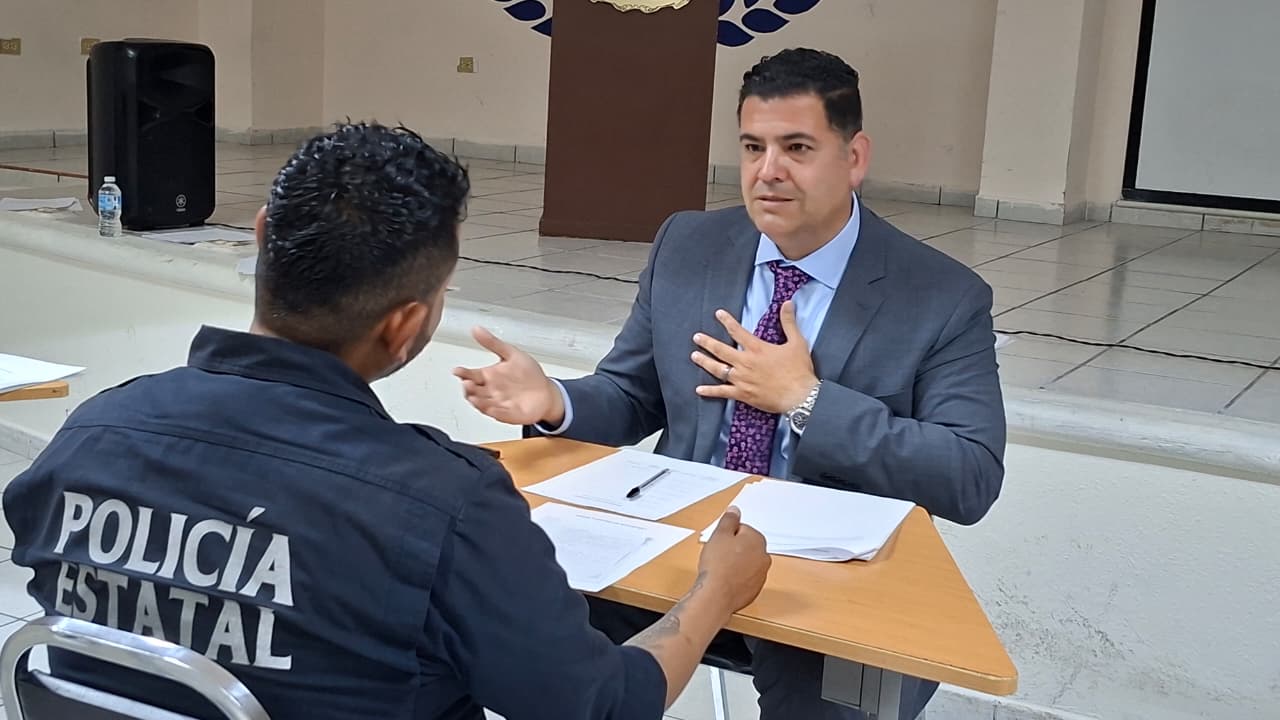
A Mexican police officer receives one-on-one instruction with a U.S. counterpart. Photo by Global Ties U.S.
Programming in 2026 took place in 4 U.S. and 2 Mexican states, and was implemented in coordination with Global Ties Network member organizations in Arizona (Global Ties Arizona), California (San Diego Diplomacy Council), Florida (Global Ties Miami), and New England (World Affairs Council of New Hampshire and WorldBoston).
U.S. program activities included four, week-long study tours focused on intelligence-led policing, training academy administration, highway patrol, and management of tactical units. Combined, the four study tours served 69 Mexican law enforcement professionals. Reflecting on the experience, one participant shared: “I gained a lot of knowledge to pass to my colleagues so we can be more professional, and we built a good relationship for coordination between institutions.”
In addition to the U.S.-based activities, 2026 LESEP programming included a series of trainings in the northern Mexican states of Chihuahua and Coahuila to strengthen cross-border security through tactical skills. Eight, week-long Mexico Training Institutes trained more than 300 Mexican law enforcement personnel on topics including patrol and interview techniques, pedestrian and vehicle stops, breach operations, and ambush response tactics. All trainings were conducted by current or former U.S. law enforcement professionals from U.S. border states.
Across all program activities, participants reported exceptionally high levels of satisfaction, with ratings ranging from 98% to 100% across key areas, including program content, organization, and overall experience. Participants reported increases in job knowledge and subject matter expertise, along with stronger professional networks and greater confidence in applying what they learned to daily work. As one study tour participant noted: “This kind of activity undoubtedly increases trust between Mexican colleagues and U.S. authorities.”

U.S. and Mexican law enforcement professionals pose for a group photo at the Coahuila Mexico Training Institute. Photo by Global Ties U.S.
The Law Enforcement and Security Exchange Program was sponsored and funded by the U.S. Department of State Bureau of International Narcotics and Law Enforcement, under a cooperative agreement with Global Ties U.S.
LESEP built on the Police Professionalization Exchange Program (PPEP), which ran from 2016-2021. Combined with PPEP, Global Ties U.S. trained 9,760 Mexican law enforcement professionals between 2016-2026. Programming engaged Global Ties Network members in 30 communities across 14 U.S. states, expanding professional networks that will support ongoing cooperation against cross-border crime. Nearly 75% of LESEP participants came from northern Mexican border states, underscoring the program’s focus on advancing U.S. security interests.
Reflecting on the program’s impact, Exchanges Program Director Marc Weinstein said: “Over a decade of programming, PPEP and LESEP strengthened professional networks and supported ongoing cooperation between U.S. and Mexican law enforcement agencies. The impact and the partnerships developed through these exchanges will continue to contribute to safer communities and strong bilateral collaboration for years to come.“