
Compiled by Gabby Stall, External Affairs Associate, Global Ties U.S.
Editor’s Note: In the summer of 2026, international agricultural professionals traveled across the United States as part of the U.S. Department of State’s International Visitor Leadership Program (IVLP) Freedom 250 Initiative to meet with American farmers, researchers, agribusiness leaders, and local communities to explore U.S. agricultural innovation, trade, and food production. Read stories from three Global Ties Network Community-Based Member organizations that hosted these visitors.
Michigan
Snapshot by Xinyu Wu, Ph.D., Michigan Council for Citizen Diplomacy
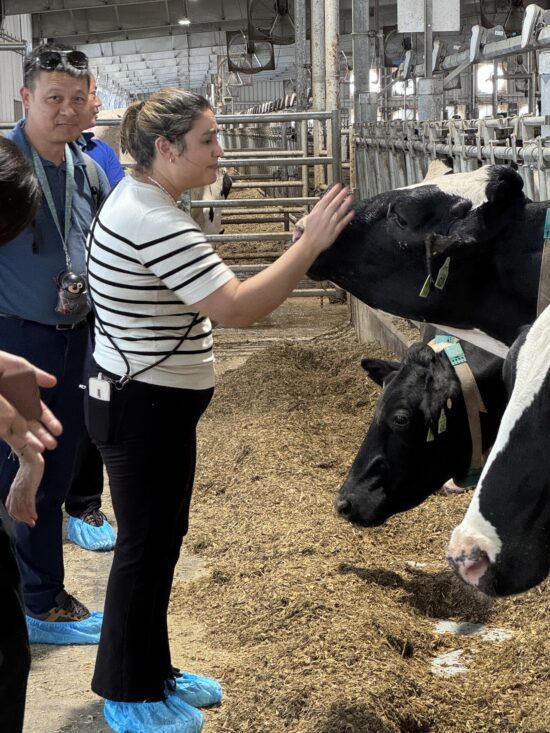
Left Photo: A participant meets a Holstein at Michigan State University’s Dairy Cattle Teaching and Research Center, photo by Xinyu Wu, Ph.D., MSU VIPP Director.
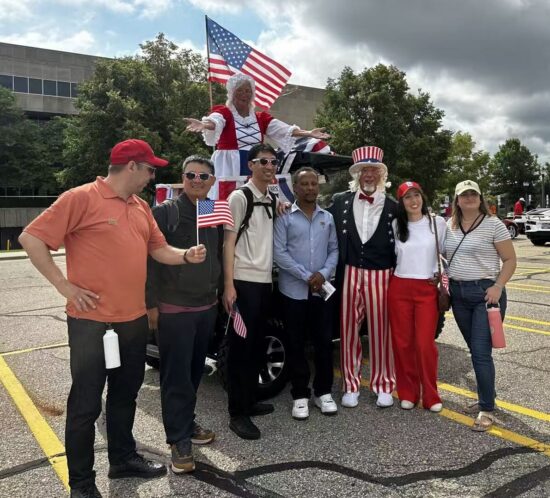
Right Photo: IVLP participants at the Lansing Independence Day Parade, photo by Xiaoqing Chen, Ph.D., MSU VIPP Assistant Director.
In Lansing, Michigan, the experience that defined a week of exploring agricultural innovation happened in a dairy barn. After a morning roundtable with Michigan State University (MSU) AgBioResearch, international visitors pulled biosecurity covers over their shoes and stepped inside the Dairy Cattle Teaching and Research Center alongside James Averill, Ph.D., Associate Director of AgBioResearch. There, one participant stood face-to-face with a Holstein dairy cow, hand outstretched. For a moment, the group fell silent before joining together in laughter. Suddenly, what had been a conversation about modernized agricultural infrastructure became something you could touch.
Beyond the dairy barn, participants were introduced to a range of research and technologies shaping the future of agriculture. Participants explored irrigation scheduling tools, nutrient recovery research, and MSU’s turfgrass science expertise that has shaped playing surfaces for mega sporting events in the United States. Taken together, the lessons of the week made the land-grant mission vividly clear: the same institution serving a Michigan dry bean grower can also serve on a global stage.
Celebrating America’s 250th anniversary gave the week a frame that could not be manufactured. During their visit, participants watched the Lansing Independence Day Parade from the sidewalk alongside local families and stayed for fireworks at Jackson Field, experiencing the holiday as residents do.
The program delivered real value to both Michigan State University and to the Lansing community. For the university, it brought faculty out of their labs and into direct conversation with international peers, allowing them to immediately test their research against conditions in other countries. For the Lansing community, the week connected the international participants to small private-sector operations, including Agape Organic Farms, where owner Shara Trierweiler discussed her specialty mushroom business. These new relationships expanded the program’s network while giving local businesses exposure to a global audience they might not otherwise reach.
Iowa
Snapshot by Hannah Schwemm, Iowa International Center
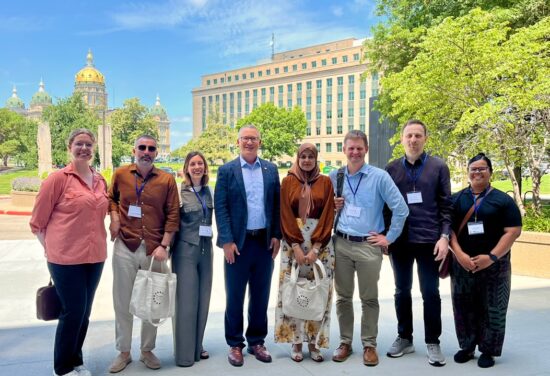
Deputy Secretary of Agriculture Grant Menke (fourth from left) and IVLP participants in front of the Iowa State Capitol Building, photo by Tina Semiti-Magembe, IVLP Liaison.
In Des Moines, Iowa, international visitors had the opportunity to engage with Iowa’s agricultural network, learning from and exchanging knowledge with local farmers, higher education institutions, organizations, and government leaders. During their time, visitors enjoyed a tour of the Johnson Family Farmstead, a corn and soybean farm in Guthrie County, known for popularizing hybridized corn varieties in the 1930s and 40s. They met with farmers to hear firsthand how modern farming operations balance tradition with innovative practices and to learn about the variety and entrepreneurial nature of American agriculture.
Visitors also learned how this expertise is developed during a meeting with the Iowa Future Farmers of America (FFA) Enrichment Center, which showcased how Iowa works to engage youth in the agricultural industry and advance agricultural education, workforce development, and leadership training for the next generation of farmers. The visit demonstrated that innovation doesn’t just happen here and now. By investing in youth, Iowa invests in future innovators and harbingers of excellence. That investment in innovation continues at the university level. Visitors engaged with Iowa State University’s (ISU) College of Agriculture and Life Sciences, where they learned how investment in innovative design and collaboration among farmers, researchers, government stakeholders, and community partners helps strengthen family farming practices and long-term agricultural resilience.
These collaborations strengthened Iowa International Center’s work while creating meaningful opportunities for community members to participate in mutually beneficial international exchanges. Public and private sector agricultural actors were able to share their mission with visitors, highlighting the crucial role of Iowa in not only national agriculture, but global agriculture and food security. Iowa’s strengths in innovation, agricultural technology, education and outreach, and resource protection were on full display throughout the program, reflecting positively on our communities.
Arkansas
Snapshot by Tommy Priakos, Global Ties Arkansas
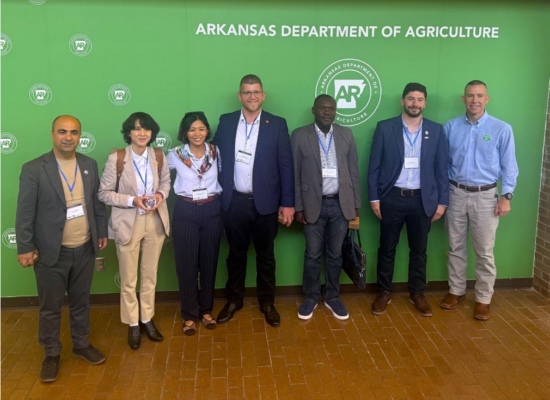
Wes Ward, Arkansas Secretary of Agriculture (right) with IVLP participants, photo by Tommy Priakos, Global Ties Arkansas
In June 2026, Global Ties Arkansas hosted international visitors as part of the IVLP Freedom 250 Initiative program focused on agricultural innovation and technology in the United States. During this program visitors explored themes of commodity crop production, agricultural policy and state leadership, risk management and farm economics, and applied research and crop innovation.
With Arkansas’s rich agricultural heritage and the fertile Mississippi Alluvial Plain it made the perfect destination to explore the best of American agricultural innovation. While highlighting Arkansas’ agriculture sector, visitors also had the opportunity to explore how innovation can spur in the face of hardship. During a visit to Riceland Foods, the nation’s largest rice cooperative, visitors gained insight into how the industry is navigating a sharp decline in rice acreage across Arkansas. Riceland Farms shared how rising production costs, particularly increases in fuel and fertilizer prices, combined with global market pressures, have contributed to temporary drying bin closures and broader challenges for producers. To help address these issues, Riceland discussed its efforts to raise awareness of the challenges facing growers and advocate for policies and export programs that support the U.S. rice industry.
The opportunity to engage with these organizations across Arkansas left a lasting impression on participants. One participant from Azerbaijan reflected:
“I was impressed by how strategically and intently the U.S. institutions support local production and safeguard the interest of growers. All of the meetings, especially the ones at the Arkansas Farm Bureau, the Arkansas Department of Agriculture, and 4-H broadened my horizons, and I believe similar initiatives could be successfully implemented in my country.”
The program also created lasting benefits for Global Ties Arkansas. Our organization established a new professional connection with Barhill Orchards, a family operated fruit and vegetable farm, and we expanded awareness of our organization in communities outside of Little Rock.